What will be the USMNT's World Cup Legacy?
What will be the USMNT's legacy following a heartbreaking loss on home turf? Whatever the legacy, it could have been so much more.

Every four years, the US Men’s National Team bows out of the World Cup, and it sparks the same old conversation.
In part because, for decades, the U.S. Men’s National Team has occupied a grim reality; while the WNT has been at the pinnacle of the sport, the MNT spent nearly 50 years without a single World Cup appearance and, until the Round of 32 win over Bosnia & Herzegovina, had spent over 20 years trying to build on the program’s only knockout win on the world’s biggest stage.
However, the 2026 edition of the USMNT felt different under Mauricio Pochettino. The era started out hot as US Soccer’s benefactors fronted the salary for one of the world’s hottest free agent managers. Pochettino brought a pedigree that allowed him to challenge the status quo, but in the end, his posturing failed to bring real change in the buildup to the first World Cup on U.S. soil since 1994.
The lead-up to the World Cup brought unease.
The former Spurs manager didn’t have much time with the best starting XI either, through injury, top players opting out of the Gold Cup, and the manager’s decision to experiment.
That recipe resulted in mixed form heading into a competition that the USMNT had spent the last 8 years preparing for, but the preparation was less built on a master plan and more built on hopes and dreams. Yet, Pochettino’s USMNT yielded an outstanding 4-1 win over Paraguay to kick things off before wrapping up the Group Stage before the final match for the first time in nearly a century.
A 2-0 knockout win over Bosnia & Herzegovina followed, another rarity, but disaster was waiting in the wake.
A controversial red card to Folarin Balogun was born out of the competition’s inconsistent use of VAR, and phone calls from a United States President (who just can’t help himself) led to a circus as the US prepared for the most important match in USMNT history up to this point.
Whether that circus affected the players is up for debate, but Belgium were certainly motivated, charging out of the gate, winning every second ball, and isolating Christian Pulisic and Sergino Dest to the point of the latter’s halftime substitution.
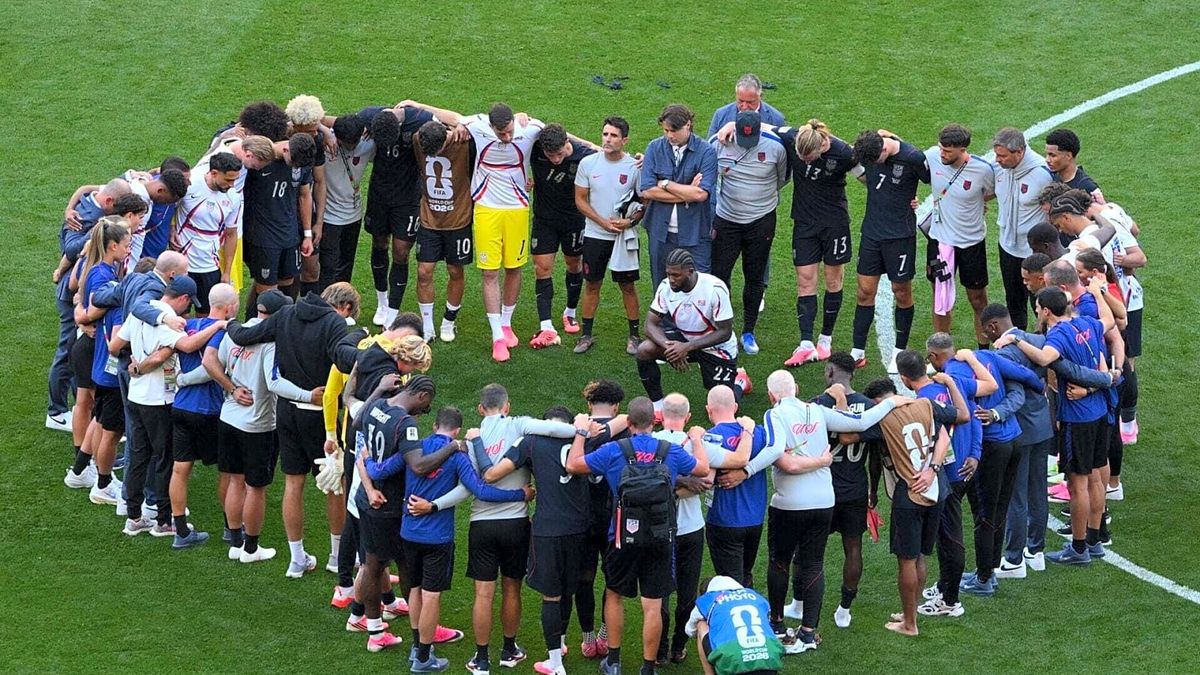
The result: a 4-1 loss where every player sans Balogun and Tillman turned in their worst performance of the competition, resulting in nearly the same outcome as every other USMNT World Cup appearance.
Miles of ink have been spilled on the reasons for the USMNT continually running into a brick wall in the round of 16, some valid, some imaginary. The performances from a few weeks earlier slipped through the narrative like sand in an hourglass as a victorious Belgium Trump danced in the locker room.
The disastrous loss kicked up another "here's the problem with soccer in America" as mainstream pundits ignore the other side of the sport, where US Soccer has become the winningest program in the world.
Is it the US’s general lack of interest in playing the sport?
A broken developmental system?
America's best athletes competing elsewhere?
The lack of promotion and relegation?
The answer is more nuanced than the same old talking points regurgitated over and over again through the decades.
The tide has been turning for a while now, even before 2017’s World Cup qualifying heartbreak seemed like a death knell for the program to those not paying attention.
The disaster in Couva was the culmination of a broken succession plan following 2014’s extra time loss to Belgium. Some have called it a missing generation, but the answer more likely lies in Jürgen Klinsmann’s influence running cold and too many cooks in the kitchen as they tried to bridge the gap between the Howard, Donovan, and Dempsey era into the era of a young Christian Pulisic flanked by the generation of Michael Bradley, Jozy Altidore, and Darlington Nagbe.
However, under the hood, progress has been made since that most famous failure.
We don’t like to give Major League Soccer the appropriate credit for the strides the US National team has taken in the interim, but the success of the Academy initiative has started to close the gap between the USMNT and the traditional football powerhouses. It’s not a finished pathway; MLS, USL, and others are always monitoring a pathway that has not only produced top league quality players, but also provided a financial windfall for clubs that have not always been profitable. That final point is more important than most realize; not enough stakeholders of US Soccer are involved for the love of the game, but if you can convince the ownership class that a top-notch Academy system can not only produce players for the 1st team but also produce a large transfer fee down the line, then the idea of low-cost and free-to-play academies is easier to stomach even with the obvious gaps and limited spots available in MLS/USL academies.
The growth of US Academies in Philadelphia, Dallas, and even in places like Birmingham has been a boon for the national team. The current outlook is a result of expanding every pathway. Players like Weston McKennie and Christian Pulisic finished developing in German youth squads before breaking through at Schalke and Borussia Dortmund, respectively, while players like Malik Tillman, Segiño Dest, Jedi Robinson, and Folarin Balogun are the result of US Soccer creatively recruiting dual nationals and tapping into the expat and birthright citizen communities.
All while a player like Tim Ream holds down the old guard of U.S. development, advancing from St. Louis Scott Gallagher to SLU to NYRB to Bolton and ultimately to Fulham, where he finally reached the top of his game. The great national teams are developing everywhere, and even in the U.S., where soccer has historically been talked down on by an older generation, the sport is reaching its tendrils into every community, thanks in large part to the US Soccer Foundation cooperating with professional clubs, finally acknowledging that better access means better opportunities for everyone.
That consistent growth, coupled with soccer’s growing pop culture relevance, resulted in over 42 million Americans hoping to watch a new zenith for USMNT soccer as they took on Belgium – doubling the viewing audience from game 7 of the recent NBA Finals.
That begs the question: Was this the biggest missed opportunity in American Sports history?
If the USMNT wins, or even just shows up like Mexico in their loss to England, then the narrative around the group is much different. The knives don’t instantly come out for Christian Pulisic following another injury, and the mainstream narrative doesn’t spend a week dissecting a problem they only pick up in 4-year cycles.
Because soccer in America has grown in leaps and bounds, a performance that was anything but uninteresting would have forced some pundits to open up to the growing reality of soccer in the States.
Soccer has become one of the biggest youth sports in the country; more people are tuning into the World Cup daily than nearly every other sporting event in the country, and the Premier League now eclipses the NHL in average American viewership.
The proof will be in the knock-on effect going forward.
Will this equate to more interest in MLS? Or will any World Cup bump be reflected in Premier League/Champions League interest this fall?
Whatever the result, it could have been so much more; it could have supercharged another growth period for American soccer.
Had FIFA not been blinded by the opportunity to extract capital at every turn, had the competition come during a time when the White House wasn’t actively hostile to foreigners, had US Soccer not wasted half of the World Cup cycle on Gregg Berhalter’s Copa América campaign (a mistake US Soccer looks willing to replicate with Pochettino in talks to extend for another 4 years), had MLS lined up the calendar shift with the World Cup year, had anyone with the power to influence soccer in America been capable of long term planning.
Instead, the viewing audience was treated to an exciting, if not frustrating, tournament that showcased what America could be as diaspora after diaspora celebrated their moment in the sun… but it could have been so much more.
The whole world isn’t here. Support staff and award-winning referees were turned away from the country; Iran was forced to move basecamp to Mexico ahead of the competition, and then were forced to leave immediately after their matches in LA and Seattle, all while many fans were denied the opportunity to celebrate their teams.
When it’s all said and done, FIFA will pack up shop with $billions of revenue, mired in a battle with UEFA, and cautiously watching as the FBI investigates AFA’s business dealings in South Florida… And what will America’s lasting legacy be?
A USMNT squad that showed promise but ultimately underperformed. A team that won over new fans before dousing them in disappointment. A president who may have ultimately exposed Gianni Infantino’s willingness to work for the autocrats. Another nail in the coffin of the FIFA-UEFA relationship.
All while a new group of teenagers is breaking through in MLS, creating dreams of a new Golden Generation to step up in the wake of the current Golden Generation’s Golden disappointment.
It's important to remember how good those wins felt before everything fell apart in one fell swoop. It's important to remember how it could have been so much more.