
The USWNT's ascendant youth.
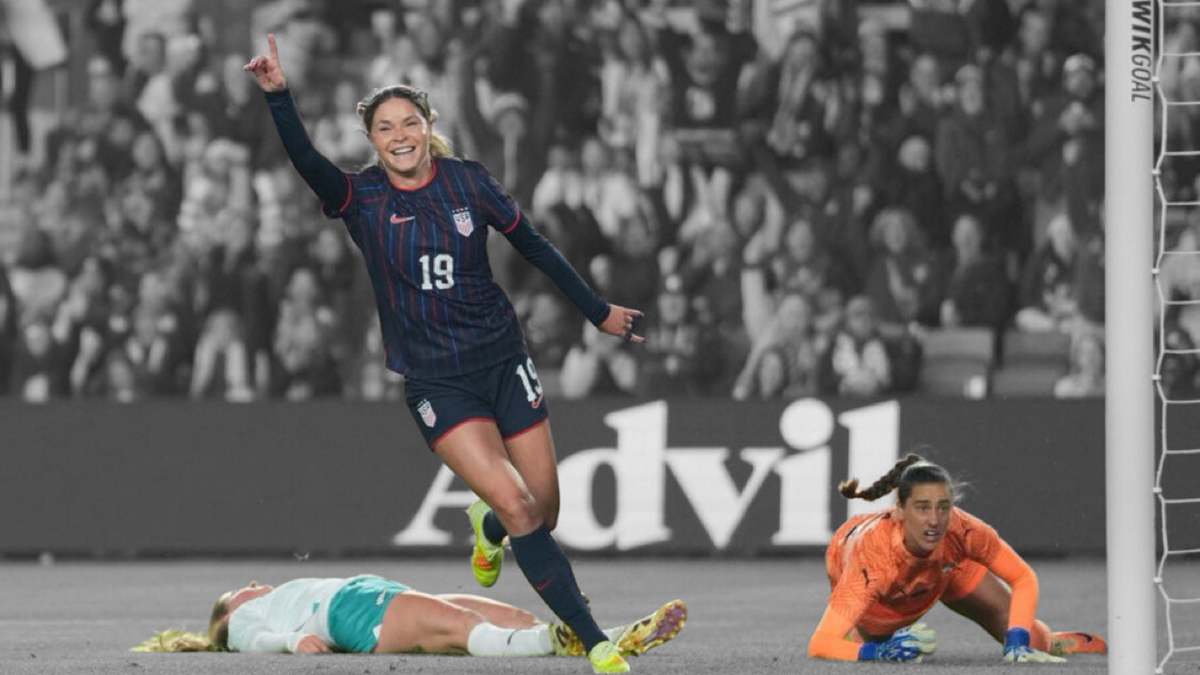
The USWNT finished October strong with a ascendant 6-0 win over New Zealand. Goals from Emma Sears, Cat Macario, and Rose Lavelle led the way.

What a window!
The USWNT wrapped things up with a 6-0 win over New Zealand in Kansas City on Wednesday night, but the window wasn’t always that smooth. Returning from the loss to Portugal last week, the US bested a Selecção das Quinas 3-1 behind another Olivia Moultrie brace and a Sam Coffey clincher. Then, firmly put the opening result in the rearview behind Emma Sears’s hat trick, Cat Macario’s Brace, and Rose Lavelle’s certified banger.
This goal goes crazy, Rose🌹 🔥 USWNT x Volkswagen
— U.S. Women’s National Soccer Team bot (@uswntbot.com) 2025-10-30T01:03:40.455Z
Reflecting on the win over Portugal, that match was one long learning opportunity:
The young midfield of Jaedyn Shaw, Claire Hutton, and Lily Yohannes was generally successful.
Olivia Moultrie can ball in Emma Hayes’s setup.
— U.S. Women’s National Soccer Team bot (@uswntbot.com) 2025-10-27T20:40:37.126Z
Hayes was able to tidy up the approach but the lone defensive breakdown was created after both sides compressed the right flank, the struggle compacted the field, and left Jéssica Silva to run into space and cause the US more trouble from the wide spaces.
Still, the US regrouped.
Whereas the opening fixture saw the US pinching play inside and relying on the wingbacks to create width, Moultrie and Alyssa Thompson pushed high into the wings the second time around.
It’s part personnel, part Hayes tweaking the approach to test some hypotheses, but the success with the pool’s competent youth saved a lot of rough drafts, opining over the US’s waning global dominance.
“They’re the future and the present.”
Hayes confided following the win, setting the stage for a barnburner in the national team’s first trip to CPKC.
New Zealand is not Portugal, and the US worked quickly to disorganize the Ferns. Michelle Cooper and Emma Sears ran wild down the flanks while the midfield of Rose Lavelle, Lily Yohannes, and Claire Hutton facilitated with Cat Macario up top.
Yohannes hoovered up the space afforded to her, dictating play all night long.
Helped by Hutton’s ability to disrupt New Zealand’s build-up, Yohannes floated from sideline to sideline, spraying passes through the lines and progressing the attack into dangerous areas.
Cat on the double ✌️ USWNT x Volkswagen
— U.S. Women’s National Soccer Team bot (@uswntbot.com) 2025-10-30T01:40:18.790Z
Yohannes had great chemistry with Cooper down the right as well, and it opened up options to either find Sears attacking from the opposite flank or to play centrally to either Lavelle or Macario.
The youth were dominant.
The average age of tonight’s starting XI was 23.1, one of the youngest that the program has ever seen, and – as US Soccer so rudely pointed out in their pre-match notes – drops to 22.5 without Rose Lavelle.
That’s the encouraging aspect of this window.
This isn’t a window where Emma Hayes is attempting to squeeze one final World Cup cycle out of a generation of USWNT greats. No. It was a window where Emma Hayes attempted to find which combination of young professionals could take the US into a new era. The world has caught up, but this new generation of players seems to relish the competition, dropping the hammer on inferior competition reminiscent of eras past.
That’s probably reading too much into one game.
Throughout the window, the US had moments of real unease against a Portugal side that finished dead last in a Euro group featuring Belgium, Italy, and Spain.
However, it does prove that despite not seeing all three of the vaunted ‘Triple Espresso’ for most of Hayes’s tenure, there are options without them… and none will be guaranteed a spot in the starting XI upon their returns.
Sears and Cooper, for instance, may be worth a revisit. “It’s so awesome playing with Michelle [Cooper].” Sears reflected in the mixed zone. “She has such a great niche ability to play balls into the box, for me to be on the end of those tonight, it was super awesome.”
2027 is still a long way away, but as the USWNT starts to look ahead to World Cup qualifying, there are some signs of trouble.
Set-piece defense was their kryptonite in the loss to Portugal, and the backline has not defended well from good service in the wide areas while Hayes prioritizes ball movement over a staunch defensive line. Luckily, Emily Sonnett is an elite veteran presence, but Hayes has yet to land on a pairing with Tara McKeown and Jordyn Bugg filling in next to her over the first two matches. Bugg was tapped in KC, slotting in next to debutant Kennedy Wesley, who might be the inverse of Sonnett’s skillset.
Then, there’s the revolving door at Fullback.
RB Emily Fox and LB Avery Patterson were deputized as LB and RB, respectively, and the decision seemed to neuter much of what has made Patterson successful in Houston this season. Then, against New Zealand, Hayes played Lilly Reale in her natural LB position while tapping Emily Sams at RB. Sams has played the position before, but has been a perennial NWSL defender of the year candidate for her play at CB in Orlando.
It feels like tinkering for the sake of tinkering. Emily Fox did not work on the left side, and the lack of width contributed to the squad’s struggles on night one; meanwhile, she has been one of the best FBs in the WSL since arriving in North London.
If the attack is an embarrassment of riches, the back end is trying to delicately balance a platform to progress into the attack without giving up the farm defensively.
Finally, there’s the conversation in goal.
At times over the past year, it seemed that Phallun Tullis-Joyce had taken the lead, but Hayes has repeatedly pushed back on any of PTJ, Mandy McGlynn, or Claudia Dickey running away with GK1. So, it was surprising when Dickey was handed the gloves for a second time this window.
The goals against Portugal weren’t PTJ’s fault for the most part, but Dickey’s form in the league almost necessitates a longer runout. PTJ made two saves on four shots against Portugal, while Dickey posted a two-save clean sheet after allowing a goal on the only shot she faced in match two.
It’s easy to read where the wind is blowing; for as good as McGlynn may be with the ball at her feet, the shotstopping of Dickey and PTJ narrows the field… especially when McGlynn’s shotstopping numbers have not been up to standard throughout 2025.
There are many unanswered questions, but this is still a national team that has only allowed three goals in their last eight matches, and outscored opponents 28-3 over that time.
Final Takeaways:
- This has to be the end of trying to cram Rose Lavelle and Lyndsey Heaps into the same midfield. They both thrive when they can push high into the attack. Forcing Heaps into more of a box-to-box role is setting her up for failure.
- The midfield competition should be Lavelle vs Heaps (and maybe Shaw), Coffey vs Hutton, and Lily Yohannes vs no one.
- Emily Sonnett remains irreplaceable.
- The US continues to look its best when it can defend on the front foot. Can they develop a secondary gameplan? So far, it hasn’t been the case despite different formational looks.
- Cat Macario now leads the USWNT in goals this year after her brace Wednesday night. Does she start over a fit Sophia Smith? Does it matter?
- Emma Sears has ascended.